
Surprising statistic: a wallet that keeps your private view keys on-device and routes every swap across decentralized markets can still leak metadata through a single poorly chosen network path. That tension — excellent cryptographic isolation versus fragile network-level exposure — is the defining challenge for privacy-focused Americans choosing a wallet today. This piece compares three practical demands: native support for privacy coins (like Haven Protocol and Monero), device-level security and hardware integration, and the convenience—but risk profile—of built-in exchange in a wallet.
Readers who value privacy need more than slogans. They need a mental model that separates cryptographic confidentiality (what the ledger records), network anonymity (who sees the traffic), and custody (who controls the keys). Below I compare how those layers interact in a modern wallet that supports Haven (XHV), Monero (XMR), Bitcoin, and numerous other assets, and show where trade-offs are unavoidable.
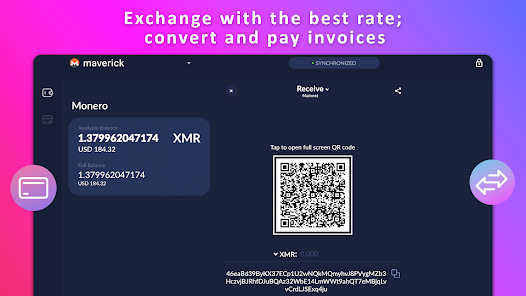
How the mechanisms layer: keys, nodes, and routing
Start with custody: a non‑custodial, open‑source wallet means private keys are generated and stored locally. That removes the central failure mode of custodial services but transfers responsibility to the device. Strong device-level protections — Secure Enclave on iOS or TPM on Android — reduce risk of local extraction, and biometric or PIN gates reduce unauthorized access in everyday use. But hardware protections are not absolute: malware that compromises the OS or tricks the user (phishing, rogue apps) can defeat local security. So the right mental model is “hardware‑assisted but not hardware‑invincible.”
Next, transaction privacy for Monero and Haven is primarily about on‑chain cryptography: ring signatures, stealth addresses, and confidential amounts for Monero; Haven shares privacy goals as a privacy coin fork with asset‑pegged features. A crucial mechanism-level detail: Cake Wallet ensures the private view key never leaves the device and supports subaddresses for Monero, which materially reduces the ability for outside observers to link incoming payments to a single public address. That markedly raises the bar against chain analysis compared with shielded or transparent-address schemes.
Finally, network anonymity. Even perfect cryptography doesn’t hide that a wallet connected to a particular node at a particular IP requested data at a given time. To reduce that risk, a robust privacy wallet offers Tor-only mode, I2P proxy support, and custom node connections. Those features cut the weakest link in many setups: the network path. But they come at cost: Tor and I2P can slow synchronization and complicate mobile reliability, and custom nodes require users to understand trust trade-offs when they choose them.
Exchange in-wallet: decentralized routing vs central intermediaries
Built-in swapping is compelling: one interface, instant conversions, and fewer on‑chain steps. But the mechanism that matters is who routes the swap. Wallets that offer decentralized routing (for example via NEAR Intents) automate matching across multiple market makers to find competitive rates without a single centralized intermediary. That design lowers counterparty concentration and preserves the non‑custodial posture: your keys stay local while smart routing composes liquidity offers.
Mechanistically, decentralized routing reduces the single point of failure but does not eliminate metadata exposure. Each routed leg can reveal counterparty endpoints and timing. In practice, using NEAR Intents-like routing plus Tor/I2P reduces linkability significantly, but it requires multiple operational components to function together: node anonymity, non‑custodial key handling, and carefully implemented swap protocols. If any part is misconfigured (e.g., using a direct node over clear internet), the privacy gains from routing can be partially negated.
Feature-by-feature trade-offs: Monero, Haven, Bitcoin, and Zcash oddities
Monero: best for native privacy. Background synchronization, subaddresses, and on‑device private view keys are the right checklist items. Trade-off: Monero’s resource needs (full‑node sync or reliance on remote nodes) and slower block finality can complicate instant swaps. The wallet’s ability to choose custom nodes and use Tor addresses this, but if you rely on public nodes you should expect more exposure.
Haven (XHV): privacy-focused and asset-flexible. Support for Haven gives users access to private synthetic assets. Mechanistically, Haven inherits privacy strengths and limits from its codebase and consensus choices. The practical risk is liquidity: fewer market makers exist for XHV than for BTC or ETH, so swap rates or slippage can be worse despite decentralized routing. Decentralized routing helps but can’t manufacture depth that doesn’t exist.
Bitcoin: privacy depends on tooling, not just Bitcoin itself. Features such as Silent Payments, PayJoin v2, UTXO coin control, and batching materially improve privacy for BTC. These are powerful when combined with hardware wallets like Ledger or an air‑gapped Cupcake solution; but they require disciplined UTXO management. The trade-off is usability: coin control and batching demand user attention or good defaults from the wallet.
Zcash: special-case friction. The wallet enforces mandatory shielding — outgoing transactions must come from shielded addresses — which is strong privacy hygiene. But there is a migration limitation: Zashi seed phrases are incompatible due to change address handling differences, so moving funds requires a manual transfer into a freshly created Cake ZEC wallet. That’s an operational friction point and a concrete example where differing protocol designs create real user costs.
Security posture in practice: hardware, open source, and telemetry
Open-source, non‑custodial architecture combined with a zero‑telemetry policy is the best configuration for skeptical users in the US who worry about surveillance, corporate data collection, or legal subpoenas. Open code allows independent audits and community scrutiny; a no‑telemetry stance minimizes long‑term data accumulation. But open source is not a guarantee of safety: quality of implementations, how build artifacts are produced, and update channels matter. Users should prefer official distribution channels (iOS App Store, Google Play, F‑Droid, or direct APK from trusted pages) and verify signatures where available.
Hardware integrations (Ledger, Cupcake) materially raise the bar for key compromise. The clear trade-off is convenience: air‑gapped signing adds steps for everyday transactions. For high-value holdings or frequent use of privacy-preserving features, it’s a reasonable trade. Remember: hardware protects private keys during signing, but does not anonymize your network traffic or swap routing by itself.
Decision heuristics: a simple three‑question framework
1) What is your threat model? If you worry mainly about on‑chain linking, prioritize Monero and subaddresses. If network surveillance matters, insist on Tor/I2P and custom node support. If custody compromise is the main fear, choose hardware integration and device-level encryption.
2) How much liquidity do you need? For frequent cross‑asset activity, prefer wallets with decentralized routing and broad market-maker coverage; for occasional, privacy‑critical transfers, using direct on‑chain conversions via OTC or self‑custody strategies may be better.
3) What level of operational complexity do you accept? Use of coin control, mandatory shielding, or air‑gapped signing improves privacy but increases cognitive and procedural load. The right balance depends on your capacity and the value at risk.
Where this approach breaks and what to watch next
Limitations are real and instructive. Network-level anonymity depends on routing: Tor and I2P strongly help but are not silver bullets, especially on mobile networks where carrier metadata and app-level telemetry (if present) create alternative linkability channels. Also, liquidity constraints for coins like Haven can produce worse price execution despite smart routing. The Zcash migration issue is a reminder that protocol design choices create irreversible operational frictions; migration and compatibility problems will remain a recurring source of user error and fund loss unless addressed at the protocol or wallet level.
Signals to monitor: broader adoption of PayJoin v2 and other collaborative transaction schemes on Bitcoin would strengthen BTC privacy; increased market maker interest in privacy coins would reduce slippage on XHV/XMR swaps; and any change to platform store policies in the US regarding Tor or I2P use could affect mobile privacy tooling. Finally, watch codebase audits and reproducible build pipelines — these are better leading indicators of long-term safety than marketing claims.
If you want to experiment with a wallet that bundles these features — multi‑currency support including Haven and Monero, Tor/I2P modes, hardware wallet integration, and in‑wallet decentralized swaps — start by testing with small amounts, enable Tor-only or custom node settings, and consider pairing with a hardware signer. For a direct starting point and verified distribution, see the official download page: cake wallet download.
FAQ
Q: Does in‑wallet swapping compromise Monero privacy?
A: Not necessarily. The swap’s privacy profile depends on both the on‑chain privacy properties of Monero (ring signatures, stealth addresses) and the swap routing. Using decentralized routing over privacy-preserving network channels preserves much of Monero’s anonymity, but if the swap involves transparent rails or a centralized endpoint, linkage risk increases. Always favor Tor/I2P and non‑custodial routing when privacy is the priority.
Q: Is hardware wallet integration required to be private?
A: No. Hardware wallets mainly protect keys from local compromise and provide an isolated signing environment; they do not, by themselves, anonymize network traffic or conceal swap counterparties. For maximal privacy you want both: hardware signing plus network anonymity (Tor/I2P) and careful use of protocol features like subaddresses and PayJoin.
Q: What should US users worry about that overseas users might not?
A: In the US, legal processes like subpoenas and the potential for platform-level policy changes (app store rules, restrictions on anonymizing tech) are practical risks. A zero‑telemetry, open‑source wallet with non‑custodial keys reduces corporate data exposure, but users should still be mindful of device backups, cloud sync settings, and local laws affecting reporting or seizure.
Q: Are there quick steps to improve privacy today?
A: Yes. Use subaddresses for recurring receipts, enable Tor or I2P where available, manage UTXOs actively for Bitcoin, and pair the wallet with a hardware signer for larger amounts. Test any in‑wallet exchange with small transactions first to observe fees, slippage, and routing behavior.